


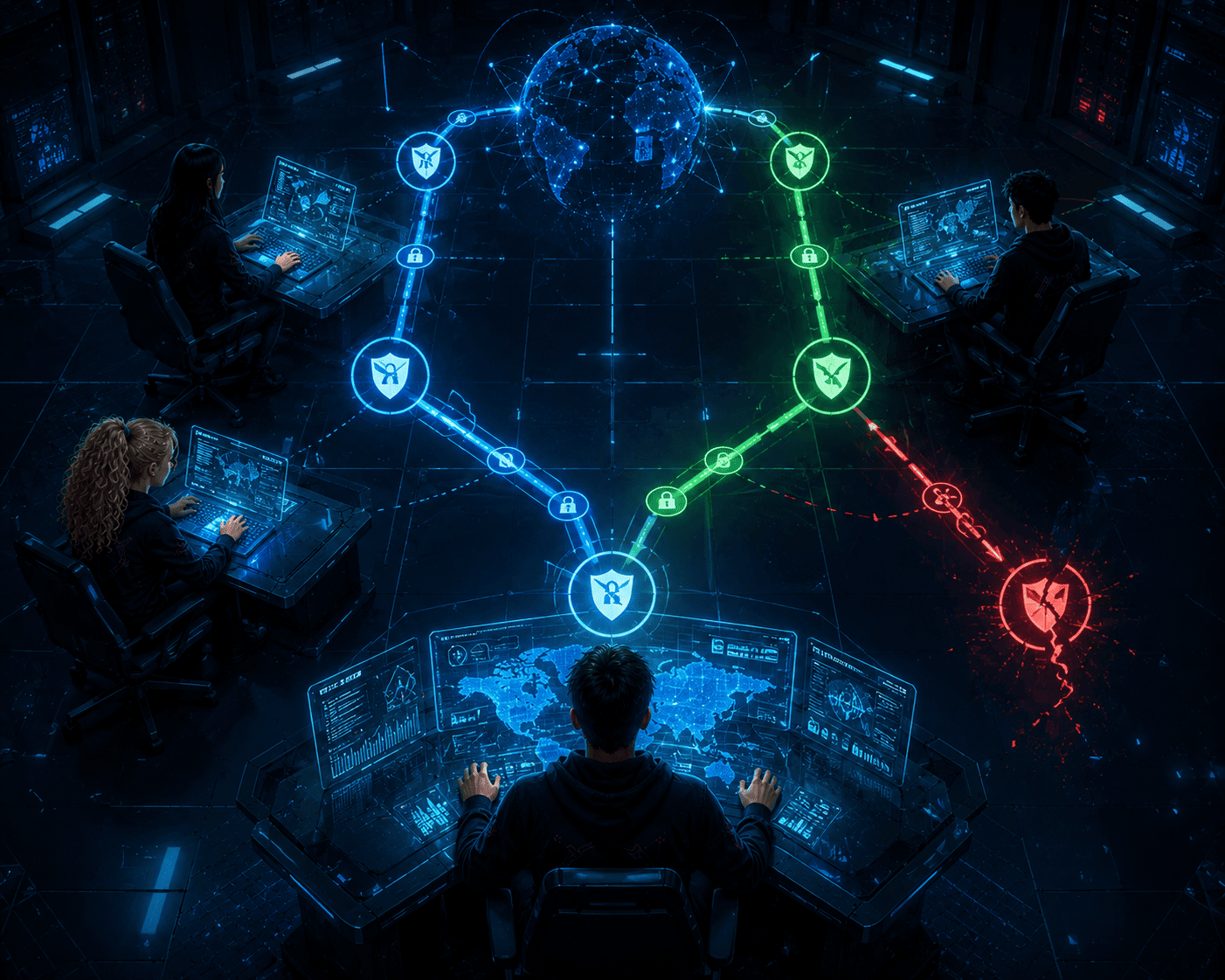
Did you catch what happened in the Crisis Room?
The Guardians didn’t move forward together.
They were split apart.
Routed through different paths.
Protected so they couldn’t be tracked.
And Rafael made it clear:
If one channel gets compromised… another takes over.
That wasn’t just strategy.
It was cyber resilience in action.
🎮 What This Has to Do With You
Now think about something simple.
You’re in the middle of an important match…
and your internet drops.
Game over.
Now imagine that happening during a real attack.
No communication,
no coordination.
No coordination…
you lose control.
🔐 The Principle Behind It
The Crisis Room used two key concepts:
👉 Encryption
The data was protected so it couldn’t be read or tracked.
👉 Redundancy
Even if one path fails, another one is already ready to take over.
⚠️ The Most Common Mistake
Most people do the opposite:
- use one single email for everything
- depend on one single password
- keep everything on one single device
👉 When that one point fails… everything fails with it.
🛡️ How This Plays Out in Real Life
Companies that survive attacks don’t rely on luck.
They:
- protect the communication between systems
- use secure channels (like VPNs)
- build alternate paths for critical data
- keep operating even when something fails
🔄 Resilience in Action
Cyber resilience doesn’t start during the attack.
👉 it starts before.
When you:
- protect your connections
- avoid depending on one single path
- build alternatives
🚀 Final Takeaway
In the Crisis Room, no one trusted a single path.
Because under attack,
a single point of failure can shut everything down.
In the digital world, whoever builds alternate routes…
keeps running even when everything goes wrong.


Deixe uma resposta