


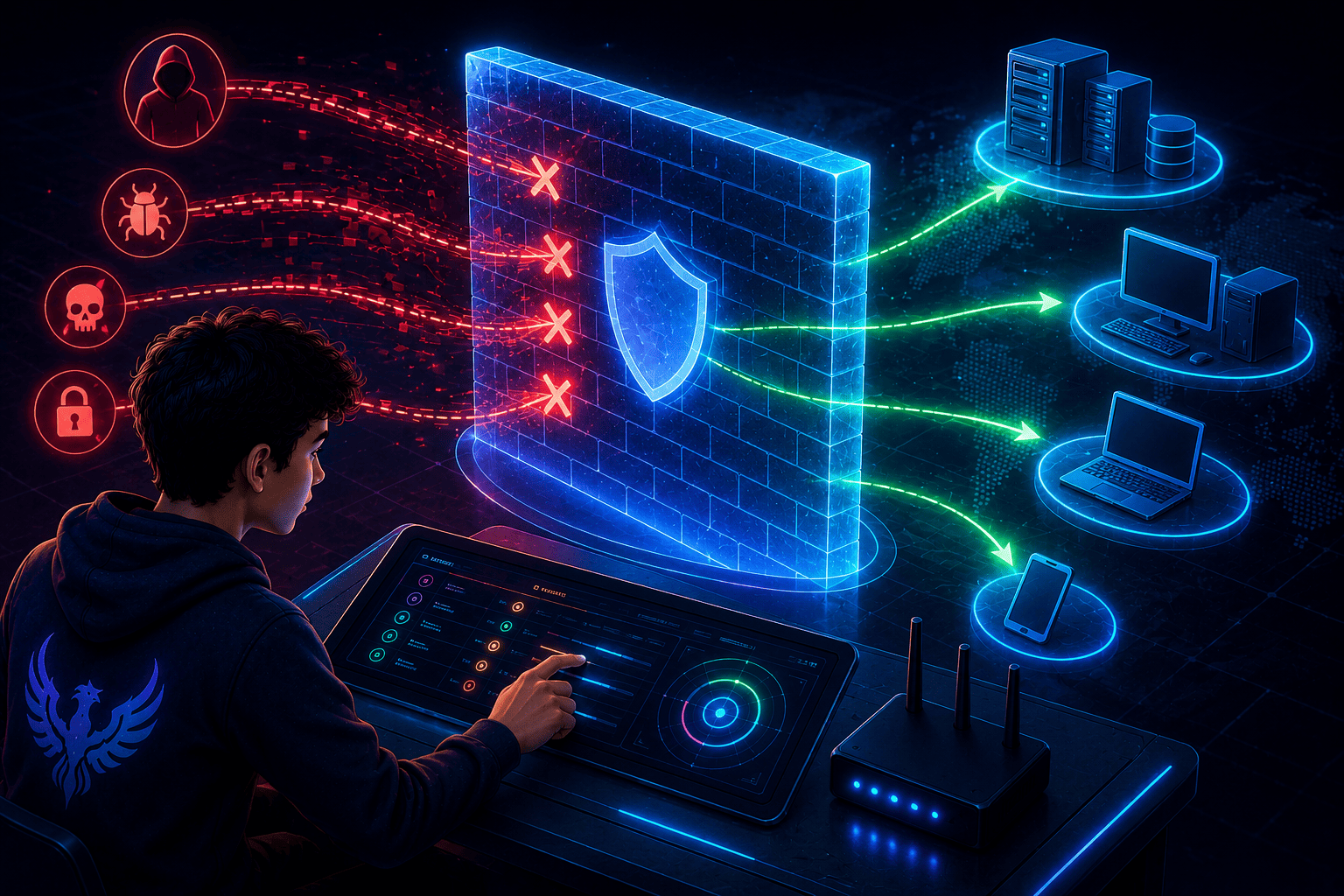
Every device connected to the internet needs protection.
Not just from viruses — but from unauthorized access.
That’s exactly what firewalls are built for.
What Is a Firewall?
A firewall is a security system that monitors and controls network traffic.
It decides:
- what is allowed to enter your device or network,
- what is allowed to leave,
- and what must be blocked.
Think of a firewall as a digital gatekeeper.
Nothing passes through without being checked first.
Why Firewalls Exist
The internet is open by default.
Without a firewall:
- your device could receive traffic from anywhere,
- attackers could scan your system,
- vulnerable services could be exposed.
Firewalls reduce risk by enforcing rules.
Cybersecurity is not about blocking everything.
It’s about allowing only what is necessary.
How Firewalls Work
Firewalls analyze traffic based on rules.
They can filter by:
- IP address,
- port number,
- protocol (TCP, UDP, ICMP),
- application behavior.
If traffic does not match the rules, it gets blocked.
Simple logic. Powerful protection.
Types of Firewalls
Packet-Filtering Firewalls
The most basic type.
They analyze:
- source and destination IP,
- ports,
- protocol type.
Fast, but limited.
Stateful Firewalls
More advanced and much safer.
They:
- track active connections,
- understand context,
- allow return traffic only if it belongs to a valid session.
This is what most home routers use today.
Next-Generation Firewalls (NGFW)
Used in professional and enterprise environments.
They can:
- inspect application-level traffic,
- detect malware patterns,
- block intrusion attempts,
- integrate with threat intelligence systems.
This is where defense becomes proactive.
Firewalls at Home vs in Companies
At home:
- your router usually includes a firewall,
- it protects devices using NAT and basic rules.
In companies:
- firewalls protect entire networks,
- separate internal zones,
- monitor traffic in real time.
Same concept. Different scale.
Why Firewalls Matter for Cybersecurity
Most attacks don’t start with malware.
They start with access.
Firewalls help:
- block unauthorized scans,
- reduce attack surfaces,
- prevent attackers from moving inside networks,
- enforce segmentation and control.
If attackers can’t reach a service, they can’t exploit it.
Common Firewall Mistakes
Many security failures happen because of configuration errors.
Common mistakes include:
- leaving unnecessary ports open,
- disabling rules “just for testing” and forgetting,
- allowing broad access instead of specific permissions,
- trusting default settings without review.
A firewall is only as strong as its configuration.
Firewalls in the Code Park Universe
Inside Code Park, firewalls act as layered defenses.
Each zone:
- has its own access rules,
- limits communication,
- triggers alerts when traffic behaves abnormally.
That’s how the Guardians stop threats before damage happens.
Why This Matters to You
Understanding firewalls helps you:
- protect your home network,
- understand how real systems are defended,
- learn core cybersecurity concepts,
- prepare for careers in networking, security, and cloud infrastructure.
Firewalls are not magic.
They are logic applied with discipline.
Key Takeaways for Young Guardians
- Firewalls control who can talk to whom.
- Security starts with access control.
- Not all traffic should be trusted.
- Good rules reduce risk.
- Firewalls are a foundation of cyber defense.
If you control the paths, you control the system.


Deixe uma resposta